Water leakage can sometimes be difficult to detect. Water Leak Detection Dubai specialists can assist property owners and identify the issues causing damp spots, stains on ceilings, peeling paint etc. Identifying the cause of the problem is essential to rectify it when you repair the stain.
Water leakage can occur in apartments, villas, offices and commercial properties in Dubai. There are many reasons this can occur, a leaking pipe can cause damp spots in your bedroom. Blocked AC drain can cause water to leak from your ceiling. Poor waterproofing can cause moisture to enter your property from the roof, balcony or bathroom.
Although similarities may exist, inspectors must conduct a reliable inspection to identify the cause of the problem. This can minimize any unnecessary work and assist property owners to make the best decisions.
Why you should investigate water leaks
Sometimes a small water stain may not seem like an urgent issue, however, it could be part of a bigger moisture issue.
Moisture can travel through piping, concrete slabs, joints etc. This can cause issues where the stain isn’t actually coming from the source. For example, a water stain on your ceiling could be coming from the bathroom, pipe joints in the property above or could be due to a water leak from your AC drainage.
If left untreated this can cause paint damage, plaster damage, bloated cabinetry, bad smells and ongoing costs to repair. Ongoing moisture can cause could growth.
Our water leak detection experts will carry out reliable testing to identify the cause of the water leak. This means property owners can save money by not carrying out any unnecessary decoration.
Common signs of a hidden water leak
Some water leaks are obvious as there will be visible dripping from piping or the ceiling. However, others can be slow and cause changes to the surfaces of your property.
A common sign is a damp spot that keeps getting larger. Other signs can be bubbling paint, discoloration to the plaster, peeling wallpaper and white mineral build up on the walls. A continual musty smell can also be a sign.
Unusual water consumption can also be a sign. If you turn off the taps and appliances but the water meter keeps running, check for a possible leaking pipe. Consider the many factors that can affect the meter.
Water stains on the ceiling can be a sign. It can be useful to know when they are occurring. If the moisture is occurring whilst the AC is running, then it may be an issue with the drainage. If the problem gets worse after raining, it can be an issue with the roof drainage or waterproofing.
These signs don’t confirm the issue; they indicate an inspection is needed to decide if it’s plumbing or external water.
How a water leak detection works
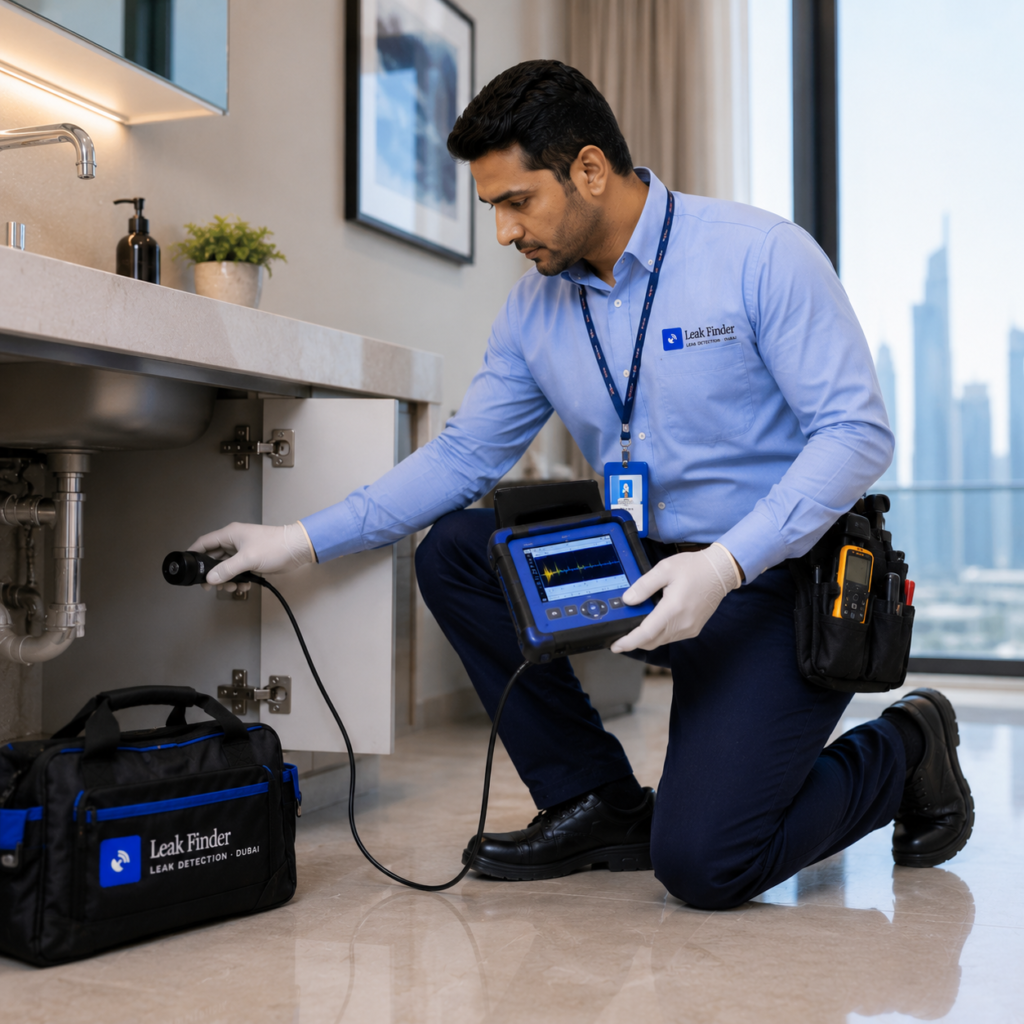
Professionals identify hidden water leaks using various techniques in modern water leak detection. This will depend on the suspected source, materials used in the building and the type of piping.
A technician will usually start by inspecting the area and ask when the issue is occurring. This can help identify the source of the damp by looking at where it is coming from, any recent maintenance, AC running patterns and changes to water consumption.
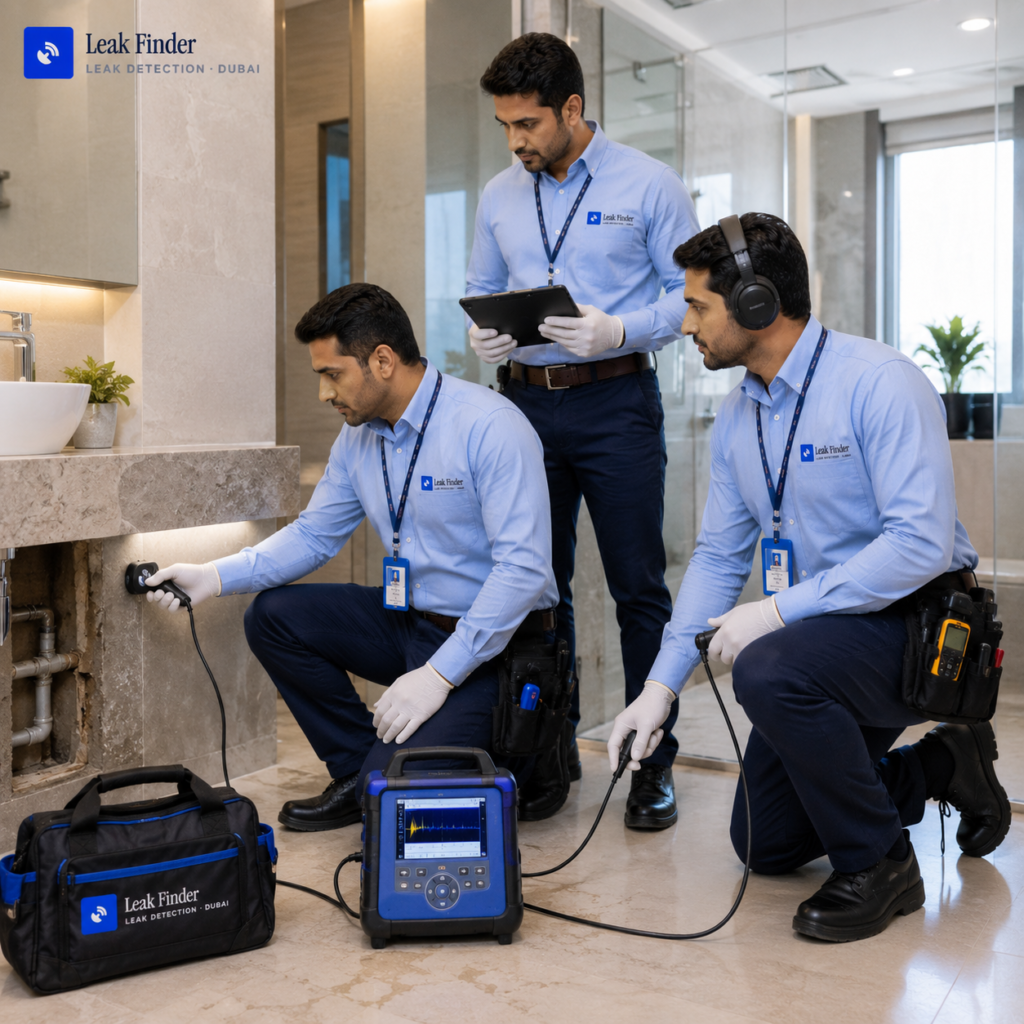
Thermal imaging identifies temperature differences that could indicate moisture. Moisture meters help identify dampness in accessible materials. Acoustic equipment can help identify where any noise is coming from on pressurized piping. Technicians may require tracer gas for some hidden piping.
There isn’t one piece of equipment that can identify every type of leak. Thermal imaging can show temperature changes but cannot confirm there is water. It is important to interpret the readings and where possible confirm with a second method.
It is important to understand the difference between identifying where an issue may be and confirming it. The aim is to gather enough evidence to know exactly where the source is.
What can thermal scanning for water leakage show?
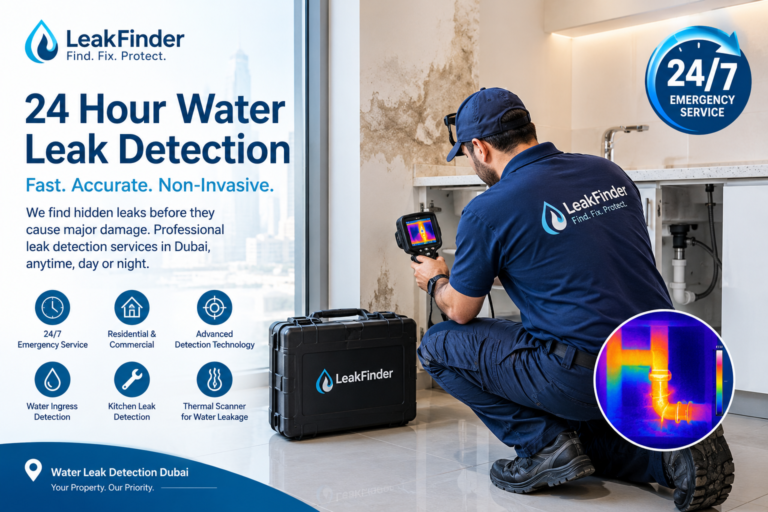
Technicians use thermal scanning to detect temperature differences on walls, floors, and ceilings to identify water leaks. This can help identify areas that need further investigation as moisture and water can affect the surface temperatures.
Leaking piping behind your bathroom wall can cause temperature differences. A thermal camera helps the technician identify where to take further readings.
However, there are limitations. Insulation, sunlight, AC, building materials and temperature differences can all affect the thermal image. A thermal camera cannot automatically confirm if there is leaking from piping or condensation.
Use this as part of a wider investigation. To confirm, we may require moisture mapping, pressure testing, acoustic testing, or another suitable method.
Using thermal imaging can help to narrow down the area. Thermal imaging narrows the area, reduces investigation work, and enables the technician to propose a targeted next step.
Kitchen Leak Detection
There are many sources of leaking in a kitchen. These can include supply piping, flexible piping, taps, waste piping of the sink, dishwashers and water filters. Many of these leaks lie hidden inside the cabinets, so a small leak remains undetected until the surrounding material begins to bloat or discolor.
Start by having a visual inspection. Look at the sink, taps, inside the cabinet and any accessible piping. Are there any water droplets, damp cabinets, bloating to the edges of the boards, loose fittings and any staining?
If the water supply is running it may be possible to turn the tap on whilst looking at any accessible piping. Consider any appliances.
A damp kitchen cabinet doesn’t necessarily mean it is leaking from the supply piping. It can be leaking from waste piping, poorly sealed sink or appliance hoses. Sometimes the water can come from an adjoining room.
Identifying the source before replacing the cabinetry and re-sealing will prevent any unnecessary work. If the leak remains hidden or the source is uncertain, our experts can pinpoint the cause with professional leak detection.
AC Water Leak Dubai
People widely use air conditioning in Dubai, so moisture from an air conditioner can be a key factor.
The AC unit removes moisture from the air during normal operation. Drain away the condensate as it collects. If there is a blockage, damage to the drainage or a faulty component this can cause water to spill.
The water leak from your AC may be dripping from the ceiling, damp around the indoor unit, water around the vent or near the AC cabinet. This will depend on the system.
It is important to not assume it is leaking from the apartment above. AC, plumbing, roof drainage and waterproofing can all cause similar signs.
If water is actively dripping near electrical equipment or lighting, do not touch the area. Get the appropriate help. If it is safe to do so turn off the AC unit.
We will conduct an investigation to determine whether the condensate drain, another AC component, or something else is the fault.
AC Condensate Drain Inspection Dubai
A technician should inspect the AC condensate drain to see how the condensate water drains. The technician may investigate the visible drain joint, look for any blockages or leaks and see if it is draining properly. The technician may need to conduct investigation to identify the source of the spillage, depending on the system and accessibility.
There could be many reasons why there is a blockage. Incorrect gradient, damaged joints, installation issues or other issues with the system.
We should carry out a proper investigation to ensure the issue is not merely clearing the blockage. If the leak returns, we may need to conduct further investigation.
For each property, a technician should investigate to fit the equipment and ensure accessibility given the different AC systems. A qualified AC technician may need to investigate any hidden components.
AC Condensation Issues Dubai
Not all condensation issues will be due to a blocked drain. AC condensation issues in Dubai can occur when humid air comes into contact with a surface that is cool enough to cause condensation.
This can occur around poorly insulated cold piping, cold metal surfaces or other areas. This can cause water droplets which can soak the surrounding ceiling, cabinetry, walls and finishes.
Condensation and a plumbing leak can look similar. Clearing the drain won’t necessarily fix condensation and adding insulation won’t fix a leaking pipe.
It can be useful to know when the issue is occurring. If you are regularly getting water droplets on a cold pipe/surface whilst the AC is running it could be condensation. If there is continual damp when the system is off there may be another source.
We should carry out a thorough investigation to identify issues with the condensate drain, insulation, moisture distribution, and system operation. Identify the cause before painting or sealing over the damp area.
AC Drain Pipe Blockage Dubai
Blockage in your AC drain pipe prevents the system from draining condensate. The way it is installed determines whether water builds up and spills from the tray.
Signs of this can be water dripping near the indoor unit, damp ceiling panels, continual damp around the AC cabinet or a leak after some running.
There may be a build up of debris causing a blockage. However, if there is continual spillage there could be an underlying issue with the drainage or installation.
Do not put any chemicals into the drainage system or dismantle anything without knowing the manufacturers requirements. This could cause damage to the components and cause further issues.
When you experience a blockage, arrange for an appropriate investigation. Check the drainage system safely. Once you have resolved the immediate issue, ensure water can be drained properly. Monitor the area for any signs of continual damp.
AC Leakage Investigation Dubai
Noticing regular leaks around the indoor unit, ceiling, vents, or nearby wall, contact us to arrange an AC leakage investigation. This can be useful if basic maintenance hasn’t resolved the issue or the source is unknown.
The investigation should look at the condensate drain, visible joints, signs of spillage and possible condensation around the cold components. Based on the findings, we may recommend further investigation of the AC system or a water leak.
It is important to know the difference between an AC issue and a hidden plumbing issue. Just because there is a stain near your AC unit doesn’t mean it is the AC. Don’t assume there is a blocked drain.
If it has been confirmed that the source is from the AC system, the correct repairs can be planned. If the evidence shows it is from the plumbing, roof or water ingress through the building then the investigation should focus on this.
This will help prevent multiple visits as the source will be identified.
Water Ingress Detection
Water ingress detection will look to identify water entering your building. This can occur from the roof, external walls, balcony, windows, foundations or other areas. Unlike a leaking supply pipe, this can be due to failed waterproofing, damaged seals or an open area.
In Dubai water ingress can occur due to rain, irrigation, water build up around external areas or failure with waterproofed areas. This can cause damp spots, peeling paint, mineral build up and damp around external walls and windows.
Knowing the pattern of the damage can help. If it is occurring after rain it may be coming from externally. If it is continual, a wider investigation may be required.
The investigation should look at the surrounding structure and how the water may be entering. This can include moisture mapping, thermal imaging, visible seals and appropriate testing of the suspected area.
It is vital to repair the correct source. Painting over the wall may make it look nicer but if water is still getting in it will cause further damage.
Wall Leakage Repair Dubai
If you need wall leakage repair in Dubai it is important to know why the wall is becoming damp. This could be from a leaking supply pipe, leaking from a bathroom fitting, AC condensation, external water ingress or other moisture source.
Depending on the cause different repairs will be required. If it is leaking from a pipe, plumbing repairs may be required. If it is water ingress repairs to the relevant waterproofing/external seal may be required. Condensation issues requiring improvements to the insulation or running may be needed.
Choosing the wrong repairs will waste money and cause the problem to return again. For example, waterproofing an internal wall won’t help if there is an active leak from a hidden pipe.
Before any repairs are carried out document the area and identify the most likely source using the appropriate testing. Once the leak has been fixed allow the materials to dry where required. Then any plastering, painting etc can be carried out.
If there has been water ingress into hidden materials further investigation may be required to see if they need drying, treatment or replacement. The correct order is to find the source, stop the water, assess the damage and make any repairs to the finishes.
What to do in an emergency water leak
An emergency water leak should be dealt with quickly. If water is running across the floor, getting into electrical areas or affecting neighboring units.
If it is safe to do so turn off the relevant water supply. Avoid any wet electrical items, sockets and lighting. Do not touch any switches or electrical items in an unsafe area. In the event of an electrical risk, contact the appropriate emergency or qualified electrician.
If you live in an apartment building let the building management or security know it may be affecting another unit or shared area. If it is coming from the AC turn off the unit when it is safe to do so. Do not dismantle or try to repair anything.
Take photos or short videos from a safe distance. This can help the technician understand what is going on.
When booking an emergency leak detection service let them know where the water is coming from, if it is actively running, when it started and if the water supply or AC has been turned off. This can help them plan the investigation.
How to choose a water leak finder in Dubai
When choosing a water leak finder don’t just look for a quick response. Ask how they identify hidden leaks, what equipment they may use and how they confirm the source before advising any repairs.
A good provider will explain the difference between identifying where a leak may be and confirming why. Depending on the situation they may use thermal imaging, acoustic, moisture meters, pressure testing, tracer gas or other suitable methods.
Ask if they will provide a report, photos, identified location and recommendations. Having a clear report can help you coordinate with your landlord, building management, maintenance contractor or insurer.
It is also a good idea to know what the cost of the investigation will be and what is included. Not all leaks will require the same equipment and investigation.
Leak Finder use non destructive methods such as thermal imaging, acoustic, moisture mapping and tracer gas. We will provide a report. See our water leak detection services in Dubai to understand how we work and book an assessment.